Tuesday, April 25, 2017

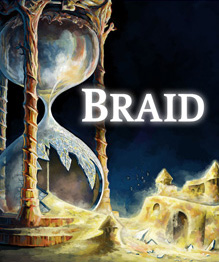
[Game Review] Braid


Note: There are spoilers here! Read with caution if you haven't played the game!


Will there ever be an auteur theory for games? Video games have a unique problem to face if ever they want to reach the atmospheric heights of the other art forms in scope and affect. Most art forms are able to have clear direction from one or a few individuals who shape it to be: the painter paints, the musician plays (or gathers some friends and plays), and the writer writes. Film is the closest medium that compares with their expansive budgets and crews, but even in this most similar case there are some concerning differences. While special effects, makeup, set design etc. may take quite a bit of independence away from the director, it is always within the range of the story. Video games, for better or worse, are rarely so dependent on the story. Given the complexity of game mechanics and the engines they run on, the technology in video games isn't flexible enough to follow a story closely.  This isn't something any art form can ever get away from, and often it is the challenge of overcoming the limitations of the medium itself that creates the most interesting works of art. But even so, given the medium's focus on interactivity over passive analysis, it doesn't make much sense to tailor the years of development on game mechanics and engine specifics to a story when it is the story that can be so easily changed. Is it not the purpose of art to communicate with the means of its medium? In video games, those means are interactivity. While a story may be easily the responsibility of one auteur, the technical aspects of games nearly always require crews of at least a few people - if not hundreds - to be made.This inherent need for diffused direction is an aspect to game design that puts games in the precarious position of either becoming something entirely new unto itself, or falling short of many art forms that came before it. It isn't that art cannot be made by the group, but that the particulars of what we consider art - the idiosyncrasies that make them feel so personal - may get lost in translation.

Nobody told Jonathan Blow that. If there has been one developer to personify the possible video game auteur, it is Jonathan Blow. Scrutinizing the particulars of how his now classic indie hit Braid was made makes it much more obvious that any such repeat of his artistic success with his subsequent identity as primary/sole artist of Braid is extremely rare. Braid wasn't just the little game that brought indie gaming to popularity, it proved that video games could be incredibly ingrained in what makes them games and still translate as art in the same metaphoric breath. The separation of story and gameplay was something that not only didn't make sense to Jonathan Blow, it was counter to what he seemed to believe in. The story was the gameplay. After all, the story in a book is what you read, the story in a film what you see, and the "story" of an album what you feel. Therefore, it stands to reason, the story of a video game is how you play.


GAMEPLAY

Braid is all about your interaction with the game conveying something deeper about the story itself, and the themes Blow wishes to express. The gameplay of Braid mimics two classic games: Super Mario Brothers and Prince of Persia: Sands of Time. The game is mostly a platformer with the rewinding gimmick from Sands of Time, only without the limitation on uses or of lives. It doesn't want to create artificial ways of holding you back or accountable. If you mess up, the game wants you to be able to easily return to the most recent position in which you can continue.

Your primary objective throughout is to reach the end of each level, collecting each of the puzzle pieces and then finally assembling the puzzle at the end of the world. Trying to collect each one of these puzzle pieces stretches your imagination of what the game mechanics can do. You first learn of simple mechanisms such as keys that unlock doors and jumping on two enemies in a row makes you jump higher. But as you continue to the next world, the mechanics take new twists, some of which continue for the remainder of the game. By the second world (called World 3, for reasons specified later) you are introduced to objects with a green sparkling cloud around them. At the beginning of each world, the game rarely gives you explicit direction, instead giving you a pit with an enemy at the bottom. In the second world, jumping down the hole allows you to steal the key with the green cloud from the enemy down there, in which your only choice of action is to rewind the game. Rewinding, you find that the key comes with you.

This kind of design is all over the game, from subtle placements of background imagery like flowers to other subtle changes in environment and level layout that always provide the answer for you without ever explicitly telling you. It is part of the reason the game feels so fresh, even playing it my second time: you get that genuine feel of discovery. And that is what the game truly wants you to feel: like you've figured it out. Not that you have bested their challenges, but that you figured out how to use the mechanics and the environment to your advantage, used some ingenuity and gathered the puzzle piece required to unlock the next world. It can be frustrating to find yourself occasionally staring at a puzzle piece just barely out of reach, but it all becomes worth it when that "ah-ha!" moment finally dawns on you. The game's mechanics are rarely too difficult to wrap your head around after the first couple of pieces, but the game often finds inventive ways to challenge your use of them.


STORY

But all of these mechanics don't exist in a vacuum: they are intertwined with the story itself. The game follows Tim, a preppy looking man who desperately searches for the Princess. At the end of each world you pull a flag down and are greeted by a dinosaur who tells some variation of the famous "Your princess is in another castle!" The plot is dotted with these nostalgic references, almost always toward Nintendo games (another level is modeled after the classic Donkey Kong arcade game). But these references give weight to the plot itself. In my basic description above, the plot is identical to that of Super Mario Bros., which, as I also said earlier, the primary game mechanics take after. Your enemies are all essentially variations of goombas and Bullit-Bills and piranah plants, and this is no accident. The game makes a point to show you what it takes its mechanics after, and occasionally even questions your motive for playing: "Are you sure there even is a princess?"

The plot of games have historically not been very engaging, and it is only recently that there has been serious reevaluation of this fact. Braid wants you to feel this, to realize that you aren't playing to save the princess at all. You are playing to discover. The plot is expressed to you vaguely through cryptic books at the start of each world, but they can only hint towards what the game is actually trying to tell you. Through these books you see numerous illusions to this so-called princess, instances in Tim's life where he made sacrifices to find her and the bizarre methods he went through to continue his search. Most notably, there is a passage where the game tells us that Tim dissected rat brains among other experiments to find the truth of the princess, and as you near the end of the game you are given a quote by Kenneth Bainbridge, one of the men who worked on the atomic bomb: "Now we are all sons of bitches." The princess herself, more than likely, is the discovery you are craving from the game. You do not play to figure the plot out so much as to learn how to get past the current challenge. Each challenge provides you a unique way of looking at the game mechanics, and each completion provides you with that satisfying moment where you finally figured it out, that "ah-ha" moment, again. Braid is a game that knows why many of us play games, and what games are truly good at: a way of looking at the world like we can figure it out.

What poor Tim is trying to figure out through the Princess is difficult to discern from the game itself, but it is obvious the Princess doesn't want to be found. The game presents its first world to you as World 2. After completing World 6 and solving each of the puzzles associated with the other worlds, you unlock World 1, which is constantly going in reverse. You see the Princess running from a knight, and you quickly chase her through various obstacles that she helps you traverse. Finally, when you get to the end of the level, you find her asleep in her bed, and the only thing to do is hit the rewind button. As you do, you realize that what you've just witnessed is an illusion: you were the monster chasing her.

Tim has many illusions involving time throughout the game. You hear of how he relives his youthful days by going home and walking routes he enjoyed or didn't enjoy in his youth. All of the time he has experienced is swollen around him, and it is implied that he can slip between these experiences. Tying with the mechanic of time manipulation, it is easy to take this literally, but when confronted with the ending it begins to look like a coping mechanism for Tim, a way for him to redefine his past in a way he can live with. This adds another level of depth to the game I could never quite follow to any conclusion I like, but it encourages me to return to the game a third time in the future. I have theories about how it ties in with discovery, how discovery can be colored by the intention of the person who discovered it, and how this could all tie back again with that quote about the atom bomb, but there are aspects I have yet to properly set within the overarching framework of the game.    

Braid, at the very least, was an incredibly clear picture of what gaming as an artform could accomplish, and with satisfying finesse. At best, it fulfilled this promise, satisfying a postmodern "having-your-cake-and-eating-it-too" that some of the greatest works strive to achieve. It made a commentary on what it wished to do while executing exactly that. Over the years since its realease, the game has become essential playing for all gamers, and it has yet to lose its impact.  

9.5

Sunday, April 2, 2017

[Game Review] Grand Theft Auto III


Note: There may be spoilers in this review! The game is pretty old, so I thought I would do a thorough review without concern for spoilers. Beware!


It sounds like a cliche at this point, but 9/11 changed everything. At the time we didn't know how much it would change, but we knew that the next bend we as a country took was going to come fast, and it was going to come hard. Before the dust had settled, out comes Grand Theft Auto III, an open world mature video game in a time where mature video games were still getting slack for being approximate to American tragedy's like the Columbine Shooting in '99. Our media consumption was something to be terrified about, something that could turn our kids into sociopaths from underneath our nose and tip an already off-kilter country over and into the abyss. It was a time for fear of everything and everyone that wasn't us.

GTA III couldn't have known about 9/11 before hand, but in a lot of ways the hysteria that followed that tragedy was the perfect fertilizer for a new type of game that gave you more personal freedom and challenged the status quo. It was the perfect time to make edgy, off-color jokes about necrophilia and bomb scares while the noise of horror every day on nightly newscasts began to coalesce into an annoying, ever present hum.GTA III was a critical and sharply satiric eye at the darkest, deepest desires of America and it's people, and the vulnerability of the time was perfect for it. Amidst the terror, we needed to see the absurdity in it all.

Whether or not GTA III actually benefited at all from its timely release date is probably not as important anymore. In the nearly 16 years since its release, GTA III has become a bonafide classic, and one of the most respected and influential games to have ever been made. It started a game series worth millions of dollars that still pushes boundaries today. Its influence is massive, and the war against it and its followup games infamous.GTA as a video game series has become a cultural touchstone similar to that of the biggest blockbuster films. At release of each subsequent entry in the series, you can rest assured that in almost any given place you go someone will be talking about it, playing it, or thinking about it.

In GTA III lay the foundation the series would follow, from its revenge plot to its violent, sociopathic tendencies. The game is equal parts sandbox and crime drama, murder simulator and comedy. I was roughly 10 at the time, and was only just starting to get into more mature games. I really liked roaming around in Driver on the PS1, but was frustrated with its limitations. I knew a friend with Resident Evil, but I never played it myself. While I never played GTA III until this last month, I remember clearly the day I first saw a friend playing it. Just months before I got a taste of mature gaming myself in the case of Twisted Metal: Black, here my friend was running through an airport, shooting rockets at police helicopters and sniping the heads off of police officers, fountains of blood spraying from his open neck. In my stomach I knew the game had to be rated M, which meant there was no way I could get my hands on it. My friend confirmed it, and for years my dreams of sociopathic raging went unsatisfied.

I got my first taste of GTA with San Andreas, a game I have never been able to beat. Another friend had his grandmother buy it when we were 15, and we spent countless hours pouring over the map and finding the most opportune places to cause mayhem. The missions were often too hard for us, who were much more accustomed to RTS or FPS games at the time, and more often than not our game nights resulted in us roaming, killing, or blowing shit up instead of progressing the plot. It wouldn't be until GTA IV that I would get my first proper GTA experience.

Approaching GTA III now, without much in the way of nostalgia to help polish over the harsher edges, I am surprised at how well the game holds up. Only in the initial few hours, when you are doing a handful of missions for the mafia on the more industrial island full of boxy, samey buildings did I really find the game's age that distracting. The game is complex, and full of surprises and references to later games I never knew were so deep seeded in the series. But it all starts with the story.      

Story

As with most GTA games,GTA III follows a story of revenge. You play as Claude (though you are never named in game), who is shot and left for dead by your girlfreind during a bank heist. Lucky for you, the cartel wants some people being transported to prison with you, and they break you out along with a guy named 8-Ball, blowing up the bridge to the neighboring island with it. You are in Liberty City, Rockstar's version of New York City, and from here on you will make your way through various criminal organizations until you find yourself face to face with the woman who betrayed you.

The story, as far as GTA stories go, is pretty run of the mill. You work for whichever criminal you can until one of them (or all of them) betray you or are eliminated and you need to find yourself a new posse to take orders from. You work your way from the mafia to the yakuza until eventually you are working for some business mogul with an odd fetish who owns every radio station in town. For the time, however, the story is pretty damn impressive. Voice acting is above par for a game of 2001, with noticable voice talents such as Kyle MacLachlan ,  Frank Vincent, and others. The plot is executed with a cinematic flair reminiscent of films by Martin Scorsese or Michael Mann, which add much needed weight to the production. While cinematic flair may be a somewhat controversial subject in today's gaming climate (should games by like films? Are they not a different medium, allowing encroachment from film into new methods of storytelling provided by interactivity? etc...), in 2001 it was something new and serious. Games where for kids in the eyes of many, and even though mature games had been made for over a decade before GTA III, people still had trouble seeing this as a new medium for adults as well. The cinematic nature of GTA III and games like Metal Gear Solid helped to start a turn in the way we view games. Because cinematic cutscenes with thought out cinematography and good voice acting alluded to film, it was like a shortcut into the more challenging atmosphere film was able to hold with films like Goodfellas or Taxi Driver. It said "we can be challenging too" and acted as a conduit for people who couldn't quite see how games weren't for kids to traverse over to this new mature playground. Which opened up the playground for even more challenging behavior.

Gameplay

The game plays out like this: you take missions from different people scattered across the map in their own locations. Either you go to the mission-giver's house or place of business, then you get a cutscene about what you need to do, then off on your mission you go. Finishing missions unlocks more missions, and sometimes even gives you new people in which to get missions from. This mechanic has become quintessential not only to GTA, but to all open world games. It allows you to provide context to certain buildings in the city, which in turn helps you familiarize yourself with the different streets in the game. It also adds an immersive element to the story. Having to drive to someone's house or stripclub to get a mission helps you believe this city actual exists and functions, even if some of the building's functionality is only noticeable in cutscenes. 

Missions vary quite a bit and allow for many different types of gameplay. At the beginning, you will be tasked with a lot of "pick up person" and "shoot person" missions, but not soon after you will find yourself transporting cargo, blowing up massive ships, or even taking a boat out to the airport bay and rocket launching a plane out of the sky so you can pick up the drugs it drops.
What GTA is most famous for, however, is the fact that you can basically kill anyone any time. See an old lady who badmouthed you? Shoot her in the head. Better yet, throw a grenade under her and watch her blow to bits. Feeling particularly pissed off at the police for merging into your lane? Go on a rampage and get your wanted level up until you have the military trying to take you out. GTA is about creating mayhem, and having fun with it. Now, on the surface to those who do not play games, this looks eerily like a sociopath simulator. It was something that made the game incredibly controversial when it was released. For anyone who plays the game, it is pretty obvious that there is nothing wrong with blowing up virtual prostitutes to get your money back. It isn't a reflection of you and your relationship to society, it is the freedom from society and its limitations. Do what you went, when you want. Steal a Lamborghini and ramp over the subway until you explode in a crowd of people. The world is your oyster, and as far as GTA III contributions to the game world, this is probably one of its most significant. The amount of freedom and unhinged creativity that can exist here is incredible, especially for over a decade and a half ago.

The most bizarre part of the game, for me as a player of the newer games, was that there was no way to view the map in game. At first, I resorted to searching for an image in Steam's overlay web browser, but eventually I just found it easier to memorize the streets and various landmarks (turn left at the Zip store to get to Ammunation....). I'm not really sure if this is a plus or not. I see a lot of positives with including the map in game as I've played the larger GTA games, which without them would have been far more difficult. That said, GTA III is the perfect size where you just might not need one. And being forced to memorize the map and its intricacies was all the more immersive. Maybe we are missing something in our modern day games by allowing you to essentially avoid memorizing the map, but I do not know. I do know, however, that deep down a part of me appreciates its omission in this game, despite my initial concerns when I started.

Texture

During the beginning of the game when you are locked to just the first island, the game can look a little bland. The game is almost always a bleak grey, with weather usually rainy, foggy, or overcast and buildings large grey boxes. The first island in particular, with its industrial theme, is very monotone. It can be a bit confusing at first (especially sans map) to maneuver in. But once that second island is unlocked (a much more interesting and varying island at that) that game really seems to open up.

As you drive around you hear the various complaints of Liberty City's citizens, and this for me was where the game began to coalesce into a whole. The entire game follows a theme in a darkly humored shade: everyone has desires of fortune and dominance, sometimes with a sexual tint, and all of them suffer to some degree. The people on the streets reflect this theme, if unambitiously: they joke about their sexuality, complain about people in their lives, and seem to value most of all their cars (although that may just be because you are stealing their cars). The entire city is a complex machine of cynicism and consumerism on the brink of eating itself.

This is where GTA III timely release date comes back together again. I don't think cynicism is inherently bad myself, but when it is used to drum up fear in a complex situation like what happened in 2001, radicalism is bred. And this is what GTA III sends up the best. What are you afraid of? Dying? Loss of country? GTA III says it is loss of comfort, loss of being on top. It says our most animalistic desires are what really trump everything when it comes right down to it, and that instead of fear we should be looking at this with humor, because when you let fear dictate how you view your own shortcomings, you let anger and selfishness overcome your decisions.


10